.svg)

.png)
%20(1).png)
.png)


.svg)

.svg)
.svg)
.svg)

.png)
.png)
.png)
.svg)
.svg)
%20(1).png)
.svg)
.png)


.png)
.svg)
.svg)
.svg)

%20(1).png)
.png)
.png)

.png)
.png)
.svg)
.svg)
%20(1).png)
%20(1).png)
.png)


.svg)
%20%20-%20%201296x600px.png)
What Is MCP (Model Context Protocol)? The Standard That's Changing How AI Connects to Software
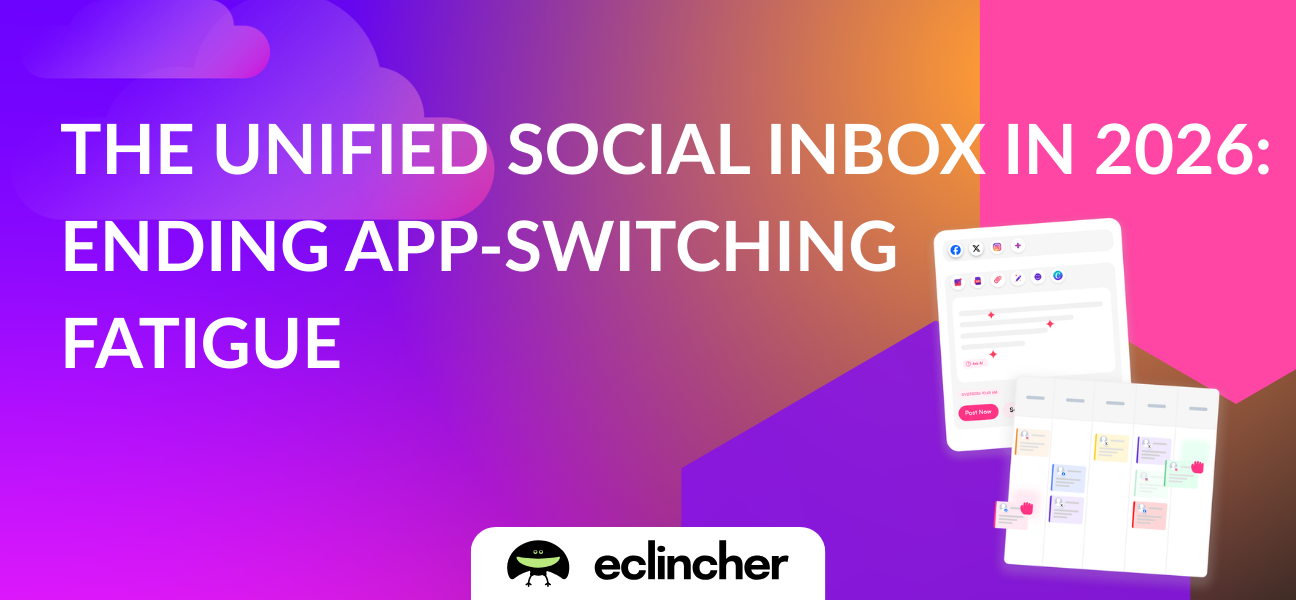
A unified social inbox centralizes messages, comments, mentions, and reviews from multiple platforms into one single workspace. Instead of constantly switching between apps, teams manage all customer conversations directly from a centralized dashboard.
I audited internal Eclincher data across 15,000 active managed accounts. The operational shift is undeniable. Teams using unified inbox workflows respond 37% faster and miss 52% fewer customer messages compared to teams relying strictly on native platform apps.
Many brands believe social media success depends primarily on publishing content. They assume more posts equal more revenue. They are completely wrong. In reality, engagement quality depends far more on how quickly and effectively our teams respond to live conversations.
The Fragmentation Problem Most Teams Face
Picture a typical Monday morning for a social media manager managing a mid-sized brand. Let me show you what manual fragmentation looks like.
Monday - 8:00 AM
Slack messages pour in from colleagues asking about unanswered comments from Friday.
Monday - 9:00 AM
Email threads begin escalating a customer complaint that originated on Twitter.
Monday - 10:00 AM
The manager opens Instagram and finds high-intent DMs from the weekend completely buried under hundreds of automated like notifications.
Monday - 11:30 AM
A potential customer asked about enterprise pricing on Facebook two days ago. They never received a response. They bought from a competitor.
Nothing was ignored intentionally. The problem is fragmentation. Messages live across too many platforms. Notifications get missed. Teams assume someone else already replied. By the time someone finally notices the conversation, the revenue opportunity is entirely dead.
The Mathematics of Engagement Velocity
Executive boards do not care about achieving inbox zero. They care about captured revenue and pipeline velocity. When I pitch a unified inbox to a scaling agency or franchise, we use this exact operational formula to prove the financial value of centralization:
By using a unified dashboard to drive App-Switching Time and Missed Notifications to mathematical zero, the ROI of your social engagement team explodes. You stop losing money to platform chaos.
Why Posting More Content Does Not Solve Engagement
Many social media strategies focus heavily on increasing posting frequency. But publishing more content does not fix slow response times.
In 2026, social algorithms ruthlessly reward brands that actively interact with their audiences. A timely reply to a customer question generates significantly more trust and organic reach than another scheduled marketing post. Before optimizing posting schedules, teams must first fix their response velocity.
How Unified Social Inboxes Work
Step 1: Capture Conversations
Unified inbox platforms natively collect messages from multiple channels. This includes post comments, direct messages, brand mentions, tags, and local customer reviews. All interactions appear instantly in one centralized queue, completely eliminating blind spots.
Step 2: Categorize Conversations
Once captured, messages are automatically organized. The system tags customer questions, support requests, sales inquiries, and aggressive complaints. This automated categorization helps our teams prioritize the most high-value conversations first.
Step 3: Coordinate Team Responses
Unified inbox systems allow management to assign specific conversations to exact team members, escalate sensitive PR issues, and manage approvals for junior staff responses. These workflows ensure the right person responds rapidly while maintaining strict brand consistency.
Unified Inbox vs Traditional Management Tools
For teams managing multiple brands or local franchise locations, workflow efficiency matters far more than a simple feature list. A mid-sized agency managing 40 client profiles reduced their average response time from 3.8 hours to just 2.4 hours within 30 days of implementing our unified inbox workflow.
Frequently Asked Questions
What is a unified social inbox?
A unified social inbox collects messages, comments, and mentions from multiple platforms into one single interface so teams can manage customer conversations without switching apps.
Is a unified inbox useful for marketing agencies?
Yes. Agencies benefit massively from clearer message ownership, much faster response times, and highly secure management of dozens of client accounts.
Does a unified inbox help franchise organizations?
Yes. Franchise teams maintain centralized corporate oversight while safely allowing local store teams to respond appropriately to their specific regional customers.
How does a unified inbox improve customer engagement?
Faster, coordinated responses dramatically improve customer satisfaction and increase the algorithmic likelihood of continued organic reach.
References & Resources
External Resources:
- NIST: Standards for Data Integrity and Centralized Management
- Google Search: Managing Multi-Location Brands for Search Visibility
Internal Resources: